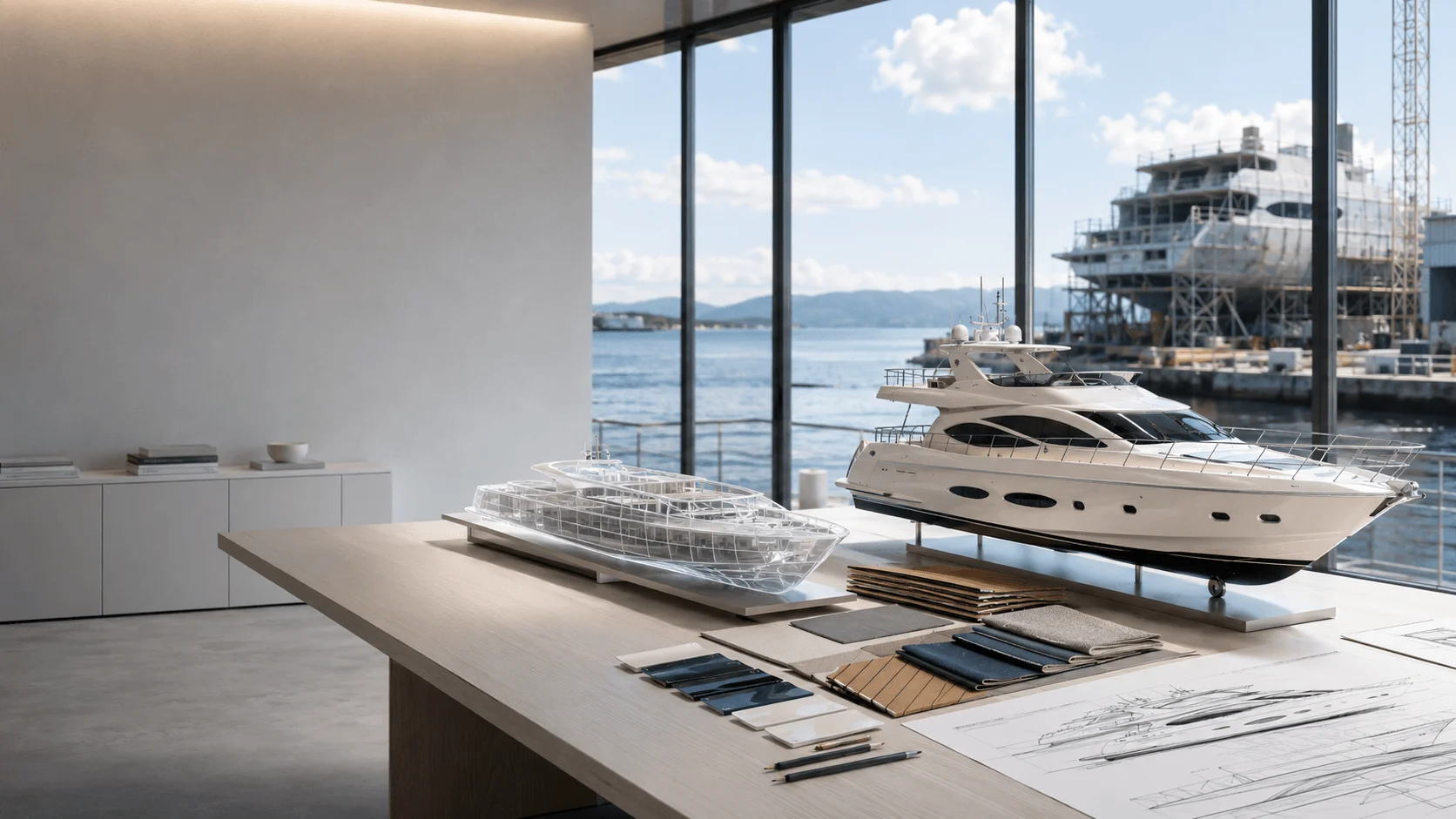
Luxury and private cruising yachts
Prioritise onboard living, indoor-outdoor space, cruising experience, styling and owner-specific equipment.
EXPLORE VESSELS BY USE
This yacht selection guide is a practical briefing for private cruising, business reception, tourism / passenger service and professional marine work from HangYu Shandong China. Published capacity cues: about 12 guests on Gianetti 48, ALASKA 47, GALENE 65, FREEGO 41 and the 66 ft yacht; the 100-pax 24 m tour boat targets scenic / urban waterways at about 11 kn. Begin with use, waters, guests, range and berth, then verify LOA, beam, draft and power on each model page. Updated 2026-11-08.
Similar LOA boats can feel very different once capacity, space mix, propulsion and yearly hours diverge. Use the scenarios below to set direction; compared with a private 12-guest yacht, a 100-pax 24 m tour boat serves bulk sightseeing instead of overnight privacy.
Prioritise onboard living, indoor-outdoor space, cruising experience, styling and owner-specific equipment.
Prioritise dignified boarding, meeting privacy, guest and service circulation, low noise and comfortable motion.
Prioritise compliant capacity, viewing efficiency, passenger flow, durability, operating cost and cleaning access.
Prioritise structural reliability, response time, mission-equipment interfaces, working deck and maintainability.
Custom builds turn real operating needs into arrangement, equipment and construction plans. Confirm each gate so experience, technical scope, budget and delivery stay aligned.
Step 1: Record use, waters, passenger plan, voyage duration, service frequency, berth, budget and target delivery. For commercial operation, identify the responsible authority and applicable rules.
Step 2: Compare use, size, material, arrangement, propulsion and maintenance capability. Separate published facts, configurable scope and values that still require engineering confirmation.
Step 3: Review the general arrangement, major systems, equipment scope, performance brief, inspection route, change control and acceptance method, then record them in technical attachments.
Step 4: Complete design approval, procurement, construction, outfitting, commissioning, inspection, trials and acceptance against milestones. Handover should include manuals, training, warranty and maintenance planning.
Practical questions buyers ask before shortlisting HangYu models or starting a custom project. Updated 2026-11-08.
This yacht selection guide is a step-by-step briefing for Chinese-built HangYu models. Suggested order: use → waters / navigation area → day guests vs overnight berths → berth limits and LOA/beam/draft → hull type and material → budget and certification. Do not start from a model name or a single price. Business reception, family cruising, sailing experience and scenic tours stress different spaces and systems—browse by use in the product centre. Inland lake, near-coast and coastal rules change design category, safety gear and survey paths. Published cues: about 12 guests on Gianetti 48, ALASKA 47, GALENE 65, FREEGO 41 and the 66 ft yacht; bulk sightseeing may use the 100-pax 24 m tour boat (~11 kn). Step 1 lock use/waters/guests/berth; Step 2 verify published specs; Step 3 list must-customise items; Step 4 move only on a signed specification.
Price moves with use, size, material, power, equipment grade, interior, certification scope and custom depth, so a one-line “how much for one boat” is not comparable. First lock the operating boundary; then align LOA, beam, draft, power, tanks and capacity on the model page; then negotiate packages (engines, genset, electronics, HVAC, interior, LSA/fire, survey scope, training and warranty) in writing. Oral numbers not in the confirmed file are not a contract price. HangYu does not publish transaction prices on the website—ask for a written configuration boundary when requesting a quote.
Neither is universally better—compared with a monohull, a catamaran usually offers more beam and social deck area. HangYu published catamaran examples: GALENE 65 (~19.80 m aluminium powercat, beam ~9.69 m, 435HP×2, fuel ~4600 L, capacity 12) and FREEGO 41 (~12.6 m sailing cat, beam ~6.45 m, aux 20HP×2, capacity 12, EU CE A). Monohull examples include Gianetti 48 (~14.70 m, CE B, 12 guests), ALASKA 47 (~15.80 m, CCS II, 12 guests) and the 66 ft yacht (~20.11 m, ~400 nm range cue, 12 guests). Compare under the same waters, people, speed definition and berth width limits before you select.
Shandong Hangyu Yacht Development Co., Ltd. (HangYu) was founded on 21 March 2014 for yacht and related craft design, build, refit, sales and delivery. The registered/production base is in Hanzhuang Shipbuilding Industrial Park, Weishan, Jining, Shandong (Shunyuan Road No. 2). Published site figures (see About): about 132,303 m² land, ~830 m shoreline, ~270 m outfitting quay. Website: https://www.chinahyct.com . Unified social credit code: 91370826095108347C.
Published capacity cues (final certificate prevails): ~12-guest private/reception yachts—Gianetti 48 (~14.70 m, CE B), ALASKA 47 (~15.80 m, CCS II), FREEGO 41 (~12.6 m sailing cat, CE A), GALENE 65 (~19.80 m aluminium cat), 66 ft luxury yacht (~20.11 m twin). Hundred-guest tourism: 100-pax 24 m tour boat (steel/FRP, design capacity 100, design speed ~11 kn) for scenic, urban waterway and reception operations. Day capacity is not the same as overnight berths; survey paths also differ.
Avoid slogans. Compared with many imported stock boats, a domestic yard such as HangYu can often deepen arrangement and equipment boundaries from interviews through contract specs. Certification may evaluate RINA, EU CE, CCS or local ZC paths per project—names and scope follow the contract and issuing body. Lead time depends on design maturity, custom depth, engine/import lead times, survey pace, owner changes and yard slots; e.g. the 66 ft page cites a reference build on the order of about two years (contract milestones prevail). Import programmes may add transport, customs and certificate conversion.
Check five points: licence name and credit code match the contract stamp; visit workshops, shoreline and outfitting quay against About-page figures; inspect yard capability certificates (e.g. CCS-related) and confirm RINA/CE/CCS/ZC paths are written into the contract; review similar material/size/use references; ensure configuration list, acceptance, change rules and warranty are explicit. Verifiable evidence beats vague “reputation” keywords.
Open https://www.chinahyct.com/products/ , browse luxury / tourism / sailing-cat categories, open a model (e.g. GALENE 65, FREEGO 41, 100-pax 24 m, ALASKA 47), review galleries and published tables (dimensions, power, tanks, capacity/design category), then use this FAQ and the comparison blocks. When enquiring, attach use, waters, people, berth limits, shortlist and must-have vs optional items. Website figures are for screening—purchase files follow confirmed drawings and certificates.
Commercial brand rankings lack a shared test protocol. Compared with a ranking list, put both boats under the same waters assumption, the same people split (day vs overnight), the same speed/range definitions, and the same load/equipment band; then judge berth fit, fuel/maintenance, space efficiency, noise/vibration, certificate path, lead time and lifecycle cost. Example method only: ALASKA 47 (~15.80 m) vs 66 ft (~20.11 m) at ~12 guests; FREEGO 41 vs GALENE 65 both cats at capacity 12 but sail vs power and very different beam/fuel.
They iterate, but Step 1 should lock use, waters, people, range, berth and mandatory approvals. Budget then compares size, material, power, equipment grade and custom depth. A total budget with no operating boundary usually yields non-comparable quotes.
Website specs are for early screening, not a substitute for the project specification. Purchase files should state sources, tolerances and test conditions, and follow confirmed drawings, contract annexes, survey files and the final ship certificates.
At least: requirements brief, general arrangement, main dimensions and capacity, hull material, power and performance targets, major equipment list, interior boundary, survey/class requirements, milestones, change rules, acceptance standards, delivery dossier, training, warranty and after-sales response.
Tell us your scenario and requirements — our team will prepare a tailored yacht plan.